
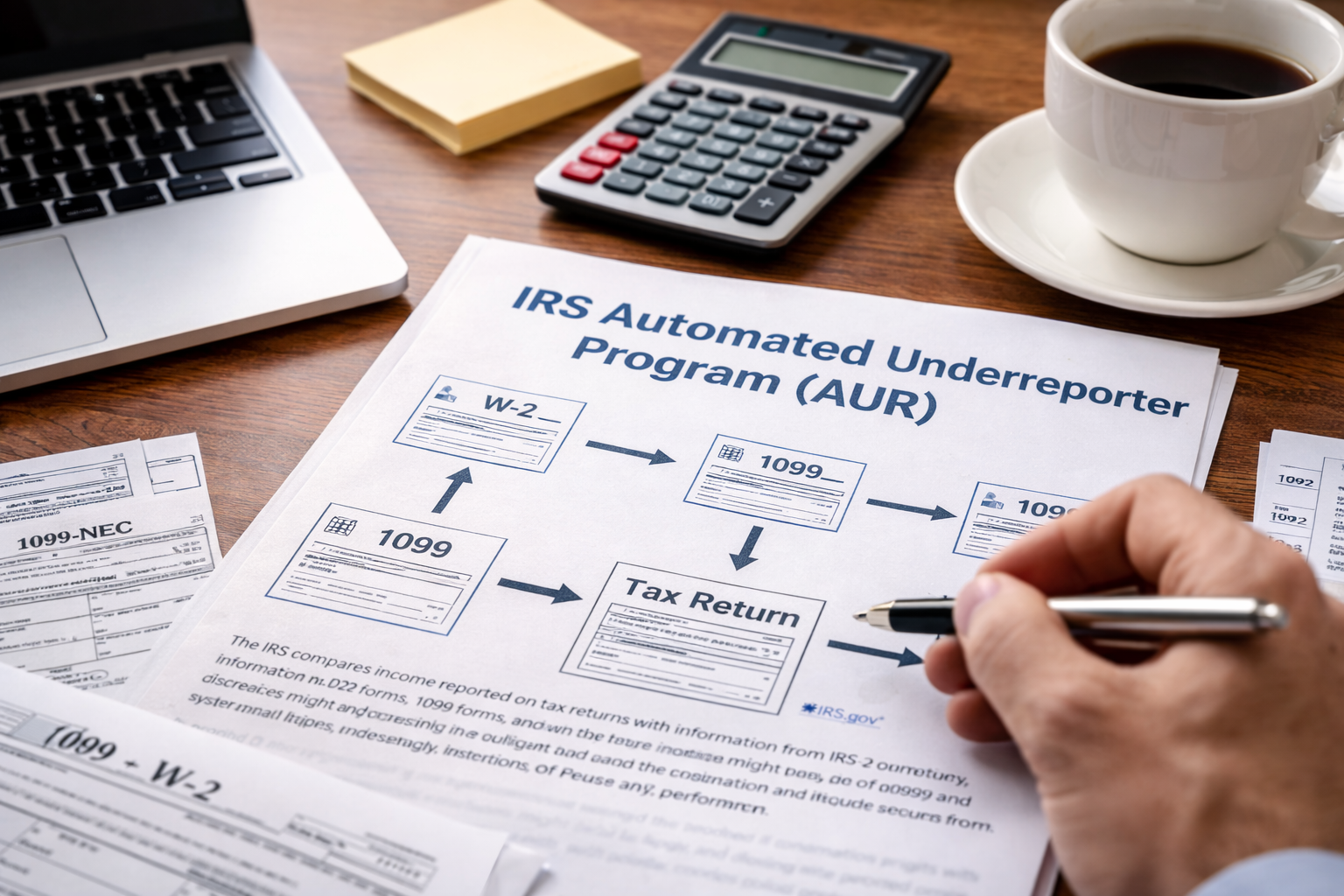
The IRS processes millions of tax returns every year, and reviewing each one manually would be impossible. To help verify that taxpayers report income accurately, the agency relies on automated systems that compare tax returns with information submitted by employers, banks, and businesses.
Key Takeaway: The IRS Automated Underreporter Program compares income reported on tax returns with third-party forms such as W-2s and 1099s, and when discrepancies appear, the IRS may send notices like CP2000 requesting clarification or corrections.
For small business owners, freelancers, and individuals who receive multiple income forms, understanding how the AUR system works can help prevent reporting errors and reduce the chances of receiving an IRS notice.
What Is the IRS Automated Underreporter Program?
The Automated Underreporter Program (AUR) is a computerized IRS system that reviews tax returns for differences between reported income and information submitted by third parties.
Businesses, employers, and financial institutions submit several types of income forms to the IRS each year, including:
- Form W-2 for employee wages
- Form 1099-NEC for contractor payments
- Form 1099-MISC for miscellaneous payments
- Form 1099-INT for interest income
- Form 1099-DIV for dividend income
Each of these forms is tied to a taxpayer through a Social Security Number or Taxpayer Identification Number. The IRS stores this data and compares it against the income reported on tax returns.
If the reported income does not match the data submitted by third parties, the Automated Underreporter system flags the return for further review.
For additional information about how the IRS verifies tax reporting, the IRS provides an overview of compliance systems here:
https://www.irs.gov/taxtopics/tc652
How the IRS AUR Program Works
The Automated Underreporter system follows a structured process to detect income discrepancies.
1. Employers and Businesses Submit Income Forms
Businesses and employers submit W-2 and 1099 forms to the IRS each year reporting wages, contractor payments, and other income.
2. Taxpayers File Their Returns
Individuals and businesses then file tax returns reporting income for the tax year.
3. The IRS Matching System Compares the Data
The AUR system compares the income reported on the tax return with the information submitted by employers and businesses.
If the numbers match, the return typically moves forward without issue.
If the numbers do not match, the system flags the discrepancy.
What Happens When the IRS Finds a Mismatch?
When the Automated Underreporter system identifies a potential discrepancy, the IRS may send a notice requesting clarification.
One of the most common notices associated with the AUR program is the CP2000 notice, which informs taxpayers that the IRS received income information that does not appear on the tax return.
If you want to understand how this notice works and what steps to take, read our guide on how to respond to an IRS CP2000 notice:
https://www.wagefiling.com/irs-cp2000-notice-how-to-respond/
A CP2000 notice typically includes:
- The income reported to the IRS
- The income reported on the tax return
- The difference between the two amounts
- A proposed tax adjustment
Receiving this notice does not automatically mean the taxpayer made a mistake. In many cases, the discrepancy comes from missing forms, reporting errors, or incorrect information submitted by third parties.
Common Reasons AUR Notices Are Triggered
Several common situations can cause the Automated Underreporter system to flag a tax return.
Missing 1099 Income
Independent contractors and freelancers sometimes forget to report income received during the year. If a business files a 1099-NEC but the income is missing from the tax return, the IRS system will likely detect the mismatch.
Incorrect Income Totals
Math errors or incorrect data entry can create differences between reported income and IRS records.
Missing W-2 Forms
If someone worked multiple jobs and forgets to include one W-2 when filing a tax return, the IRS system will detect the missing income.
Incorrect Taxpayer Identification Numbers
Errors involving Social Security Numbers or Taxpayer Identification Numbers can also lead to mismatches between IRS records and the tax return.
How Businesses Can Help Prevent AUR Issues
Although the Automated Underreporter Program focuses on taxpayer returns, businesses play an important role in preventing discrepancies.
Accurate reporting helps reduce the likelihood that contractors or employees will receive IRS notices later.
Verify Contractor Information
Businesses should collect Form W-9 from contractors before issuing 1099 forms to confirm the correct taxpayer identification number and legal name.
File Forms Correctly and On Time
Late or incorrect filings can lead to reporting inconsistencies that trigger discrepancies during IRS matching.
Use Reliable E-Filing Systems
Electronic filing systems help reduce data entry mistakes and ensure accurate information is submitted to the IRS.
Why the AUR Program Matters for Small Businesses
Many small businesses issue 1099 forms to contractors, vendors, and freelancers. These filings become part of the IRS information matching system.
If a business reports payments incorrectly or fails to issue required forms, it can create confusion or discrepancies for the people receiving those payments.
Using reliable 1099 e-filing software and verifying contractor information can significantly reduce the risk of mismatches and IRS notices.
Understanding how the IRS Automated Underreporter Program works helps both businesses and taxpayers improve reporting accuracy and avoid unnecessary compliance issues.
Frequently Asked Questions
What is the automated underreporter program?
The IRS Automated Underreporter Program is a computerized system that compares income reported on tax returns with information submitted by employers, banks, and businesses through forms such as W-2 and 1099.
What does AUR stand for in the IRS?
AUR stands for Automated Underreporter, the IRS program responsible for identifying discrepancies between taxpayer returns and third-party income reports.
What happens if I underreport my income?
If the IRS detects unreported income through the Automated Underreporter system, it may send a notice requesting clarification. If the discrepancy is confirmed, additional taxes, penalties, or interest may apply.