
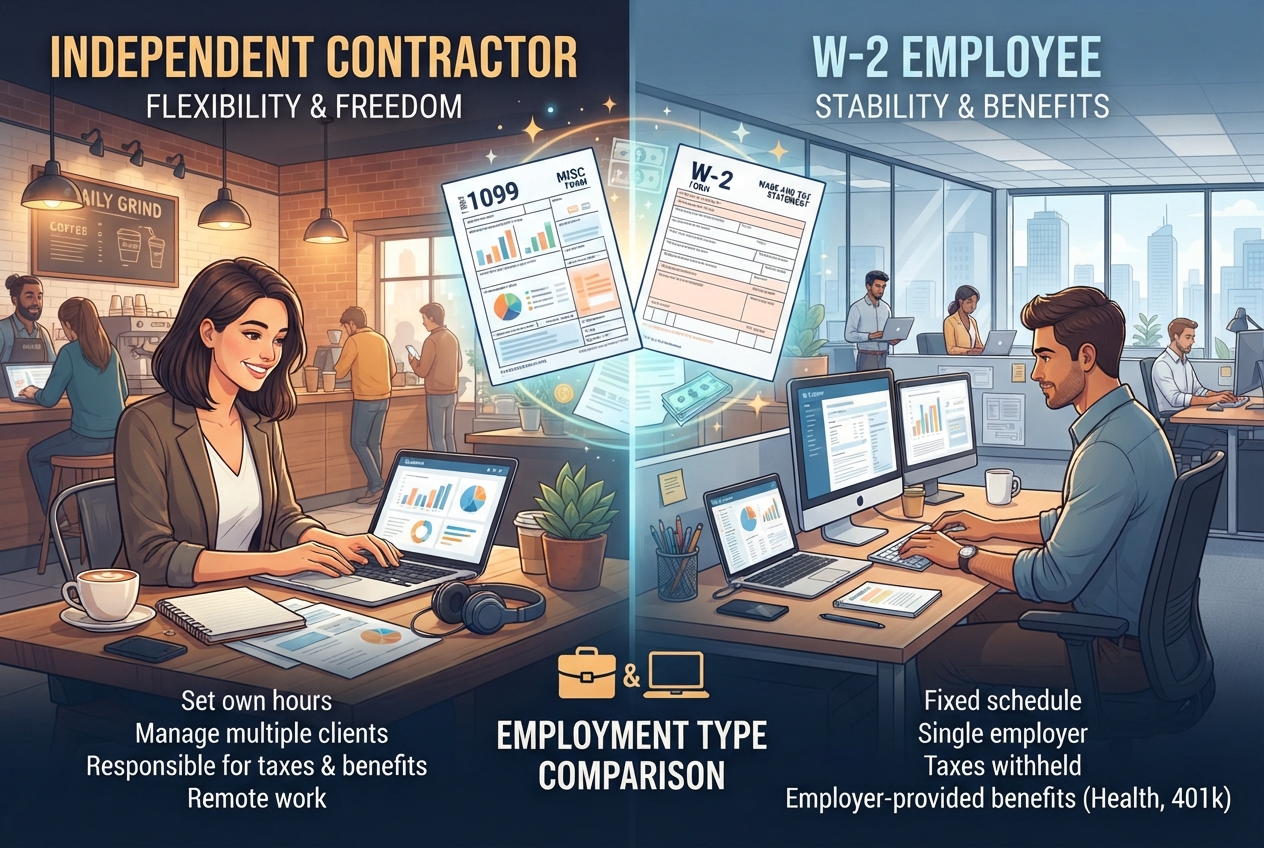
A 1099 is a tax form used to report payments made to independent contractors, while a W-2 is used for employees. The primary difference lies in the level of control a business has over the worker, including how, when, and where the work is performed. For a business owner, choosing the wrong form can lead to significant tax liabilities and legal penalties from the IRS and Department of Labor.
Key Takeaway: Misclassifying an employee as a contractor can result in back taxes, unpaid overtime claims, and heavy IRS fines, making it essential to evaluate worker status before the tax year ends.
What It Is: Understanding the 1099 and W-2 Distinction
The 1099-NEC is the specific form used to report non-employee compensation. You use this form when you pay an independent contractor $600 or more during a calendar year for services performed for your trade or business. Contractors are responsible for paying their own self-employment taxes, including both the employer and employee portions of Social Security and Medicare.
In contrast, a W-2 is for employees who are part of your regular payroll. When you hire an employee, you must withhold income tax, Social Security, and Medicare from their wages. You also pay a matching portion of payroll taxes and provide benefits like unemployment insurance and workers’ compensation coverage. The distinction is not just about paperwork: it is about the legal nature of the relationship.
The IRS looks at the “Common Law Rules” to determine worker status. These rules fall into three categories: behavioral control, financial control, and the relationship of the parties. If you control the specific details of how a worker completes a task, the IRS likely views that person as an employee, regardless of any signed contract stating they are a contractor.
Who It Applies To: Identifying Your Workers
Independent contractors are typically specialists who provide services to the general public. They often have their own equipment, set their own hours, and work for multiple clients simultaneously. Examples include freelance graphic designers, outside consultants, or specialized repair technicians who visit your office occasionally.
Employees are usually integrated into the core operations of your business. They often work a set schedule, use company-provided tools, and receive training on how to perform their duties. If a worker is essential to the daily functioning of your business and you direct their every move, they are almost certainly an employee.
It is a common mistake to think that hiring someone for a “short-term project” automatically makes them a contractor. Duration is a factor, but it is not the deciding one. Even a temporary worker can be an employee if you exercise significant control over their work process. You must evaluate each worker individually based on the actual reality of their daily tasks.
Requirements for Filing and Compliance
For contractors, you must collect a Form W-9 before you issue their first payment. This form provides you with their legal name and Taxpayer Identification Number (TIN). At the end of the year, you use this information to file Form 1099-NEC. You must provide a copy to the contractor and the IRS by January 31.
For employees, the requirements are more intensive. You must collect Form W-4 for tax withholdings and Form I-9 to verify employment eligibility. You are responsible for calculating and depositing payroll taxes on a regular schedule, usually monthly or semi-weekly. You must also file quarterly Form 941 reports to the IRS to summarize your payroll activity.
If you are unsure about a worker’s status, you can file IRS Form SS-8. This form asks the IRS to officially determine the worker’s status for you. However, be aware that the IRS almost always leans toward an employee classification because it ensures more consistent tax collection.
The Mid-Year Course Correction: What to Do If You’ve Been Treating a Worker Wrong
Many business owners realize halfway through the year that a “contractor” is actually functioning like an employee. Perhaps you started giving them more direction, or they began working exclusively for you. If you find yourself in this position, do not wait until January to fix the problem. Mid-year is the best time to transition a worker to payroll.
First, have an honest conversation with the worker. Explain that for compliance reasons, you need to move them to a W-2 status. This change often benefits the worker because they will no longer have to pay the full 15.3% self-employment tax. You will now cover half of that cost for them. They also gain access to unemployment benefits and other legal protections.
Second, determine the “catch-up” requirements. You may need to begin withholding taxes immediately and adjust your internal accounting. It is often cleaner to start the W-2 status on the first day of a new quarter. You will still issue a 1099 for the payments made during the first part of the year and a W-2 for the remainder. This “split year” approach is common when businesses grow and formalize their operations.
Third, consider the risks of past misclassification. If the worker has been an “employee” in practice for years, you might owe back taxes. The IRS offers a Voluntary Classification Settlement Program (VCSP) for businesses that want to move workers to employee status for future periods. This program provides partial relief from federal payroll taxes for eligible employers who agree to treat workers as employees moving forward.
Common Mistakes and IRS Scrutiny Risks
One of the biggest mistakes is assuming that a worker’s preference dictates their status. A worker might ask to be paid “under the table” or as a contractor to avoid withholdings. The IRS does not care about these agreements. If the facts of the relationship point to employment, you are liable for the taxes regardless of what the worker wanted.
Another risk involves the “Automated Underreporter” program. The IRS uses sophisticated software to match 1099 forms against individual tax returns. If a contractor reports a high amount of income from only one source, it can trigger a red flag. The IRS may investigate whether that “contractor” is actually an employee who should have been on payroll.
You should also be careful about difference between W-2 employees and 1099 contractors by reviewing your contracts. Using an “Independent Contractor Agreement” is helpful, but it is not a shield. If the contract says they are a contractor but you treat them like an employee, the IRS will ignore the contract and focus on your actions.
Best Practices for Small Business Owners
To protect your business, maintain a clear file for every contractor. This file should include a signed W-9, a written contract, and copies of invoices. Invoices are crucial because they prove the contractor is running their own business. Employees do not typically send invoices for their time; they submit timesheets to a payroll system.
Review your worker classifications at least once a year, preferably in June or July. This gives you enough time to make changes before the busy year-end filing season. If a contractor’s role has expanded to include managing other people or using company equipment daily, it is time to re-evaluate their status.
Always use a professional filing service to handle your year-end forms. Manual filing is prone to errors, and the IRS has strict electronic filing requirements for businesses with many forms. Keeping your records digital and organized makes it much easier to respond if the IRS ever questions a worker’s classification.
How WageFiling Helps
WageFiling simplifies the complex world of 1099 and W-2 compliance. Our platform allows you to easily import worker data and file forms directly with the IRS and Social Security Administration. We handle the electronic filing and can even mail recipient copies on your behalf, saving you hours of manual work.
Whether you are issuing a 1099-NEC to a freelancer or a W-2 to a full-time staff member, our system ensures your data is formatted correctly. We provide a secure way to manage your filings, reducing the risk of late penalties or data entry errors. By using WageFiling, you can focus on growing your business while we take care of the tax reporting logistics.
Conclusion
Understanding the difference between a 1099 contractor and a W-2 employee is vital for any small business owner. Misclassification is a costly mistake that can lead to audits and financial strain. By identifying the true nature of your worker relationships and making mid-year corrections when necessary, you protect your company’s future. Stay proactive, keep thorough records, and use the right tools to ensure your business remains compliant with all IRS regulations.
Frequently Asked Questions
Can a worker be both a contractor and an employee in the same year?
Yes, a worker can transition from a contractor to an employee. In this case, you would issue a 1099-NEC for the period they were a contractor and a W-2 for the period they were an employee. You must ensure the change in status reflects a real change in their job duties and your level of control over their work.
What are the penalties for misclassifying an employee as a contractor?
Penalties can include paying both the employer and employee shares of Social Security and Medicare taxes, unpaid unemployment taxes, and interest. You may also be liable for unpaid overtime under the Fair Labor Standards Act and face fines for failing to file the correct tax forms.
Does a signed contract prove someone is an independent contractor?
No, a contract is only one piece of evidence. The IRS prioritizes the actual behavior of the parties over the language in a contract. If you provide the tools, set the hours, and supervise the work closely, the IRS will likely classify the worker as an employee regardless of what the contract says.
Disclaimer: This article is for informational purposes only and should not be considered tax, legal, or accounting advice. Consult a qualified tax professional regarding your specific situation.