
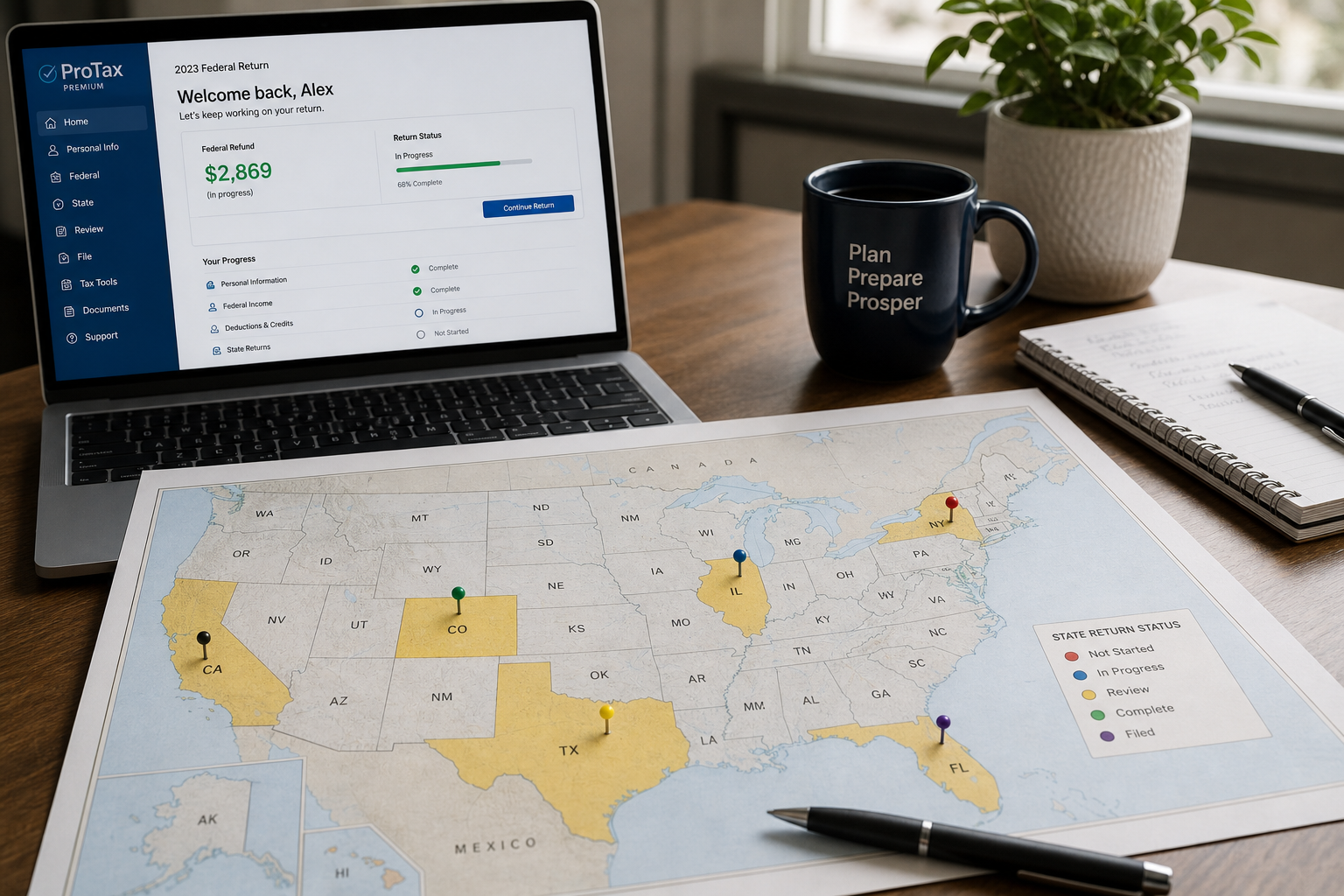
Yes, many states require you to file 1099 forms at the state level in addition to filing with the IRS. The requirements vary by state. Some states participate in the IRS Combined Federal/State Filing (CF/SF) Program, which automatically forwards your federal 1099 data to the state. Other states require a separate filing directly with the state tax agency. A few states have no state income tax and do not require 1099 filings at all.
Key Takeaway: Do not assume that filing your 1099s with the IRS covers your state obligations. Check your state’s specific requirements each year, because state rules change and the penalties for non-compliance can add up quickly.
What It Is
State 1099 filing is the process of reporting the same income data you report to the IRS to your state’s tax or revenue department. The purpose is the same: to help the state verify that income recipients are reporting and paying state income taxes on the payments they receive.
Most states that impose an income tax also require some form of information return reporting. The specifics depend on the state. Some states require copies of all 1099 forms. Others require only certain types (such as 1099-NEC or 1099-MISC). Some states set their own dollar thresholds or filing deadlines.
There are three main approaches states use:
Combined Federal/State Filing (CF/SF) Program. More than 40 states and the District of Columbia participate in the IRS CF/SF Program. When you e-file your 1099s with the IRS and indicate the applicable state(s), the IRS automatically forwards the data to the participating state(s). This is the simplest method for businesses.
Direct state filing required. A few states do not participate in the CF/SF Program or require additional filings beyond what the IRS forwards. In these cases, you must file directly with the state, often through the state’s own electronic filing portal.
No state filing required. States without a state income tax (Alaska, Florida, Nevada, South Dakota, Texas, Washington, and Wyoming) generally do not require 1099 filings. However, some of these states may still require filings in specific situations, such as for state withholding.
Who It Applies To
State 1099 filing applies to any business that makes reportable payments to recipients in states that require information return reporting. This includes:
- Businesses that pay contractors or vendors who work in or reside in states with income taxes
- Property owners or managers who pay rent-related services in multiple states
- Multi-state businesses with contractors in different states
- Businesses that withhold state income tax from payments
Even if your business is located in a state without income tax, you may still need to file state 1099s if you pay contractors who live or work in states that require them.
If you have already filed 1099 forms in a specific state, such as filing 1099 forms in Texas, understanding the broader state filing landscape will help you manage multi-state obligations.
Requirements
State 1099 filing requirements differ by state, but here are the key elements to understand.
Determine which states require filing. Review the tax agency website for each state where you pay contractors or vendors. States participating in the CF/SF Program are listed in IRS Publication 1220, which provides specifications for electronic filing.
Check state-specific thresholds. Most states follow the federal $600 threshold for 1099-NEC reporting. However, some states set lower thresholds or have different rules for specific form types.
Meet state filing deadlines. Most states align their deadlines with the federal deadlines (January 31 for recipient copies, February 28/March 31 for IRS filing). Some states have different deadlines. Check each state’s requirements to avoid late-filing penalties.
Use the CF/SF Program when available. If you e-file with the IRS and the applicable states participate in the CF/SF Program, opt in to have the IRS forward your data. This eliminates the need for a separate state filing in most cases.
File directly for non-CF/SF states. If a state does not participate in the CF/SF Program, you must file directly with the state. Some states offer their own electronic filing portals. Others accept paper filings.
Report state withholding. If you withhold state income tax from any payments, you must report the withholding on the 1099 form and file with the applicable state. State withholding information appears in Boxes 12 through 14 of Form 1099-MISC and Boxes 5 through 7 of Form 1099-NEC.
Common Mistakes
Businesses frequently make errors with state 1099 filings.
Assuming federal filing covers all states. The most common mistake is believing that filing with the IRS automatically satisfies all state requirements. While the CF/SF Program handles many states, it does not cover all of them. You must verify each state’s participation.
Filing only in the business’s home state. If you have contractors in multiple states, you may need to file in each state where a contractor works or resides. The filing obligation often follows the contractor’s state, not your business’s state.
Missing state-specific deadlines. Some states have earlier deadlines than the federal deadlines. Missing a state deadline results in state-level penalties, which can apply per form.
Not opting into the CF/SF Program. When e-filing with the IRS, you may need to specifically indicate that you want to participate in the CF/SF Program. Failing to opt in means the IRS will not forward your data to the state.
Ignoring state withholding requirements. Some states require withholding from payments to non-resident contractors. If you are required to withhold and fail to do so, you may owe the withheld amount plus penalties.
Best Practices
Follow these steps to manage state 1099 filing requirements effectively.
Create a state filing checklist. At the beginning of each year, list every state where you have paid contractors or vendors. Research each state’s 1099 filing requirements, deadlines, and CF/SF participation status.
Use the CF/SF Program wherever possible. This is the easiest way to satisfy state filing requirements. When you e-file with the IRS, indicate the applicable states and the IRS forwards the data for you.
Centralize your filing process. Use a single platform for both federal and state filings. This reduces the chance of missing a state or filing inconsistent data between the federal and state returns.
Track state withholding. If any state requires withholding from contractor payments, set up a tracking system to record the amounts. Report the withholding on the 1099 form and remit the withheld amounts to the state on time.
File early. Filing early gives you time to correct errors before the deadline. It also reduces the risk of missing a state-specific deadline that falls before the federal deadline.
Consult a tax professional for multi-state situations. If your business pays contractors in many states, a tax professional can help you navigate the varying rules and avoid compliance gaps.
How WageFiling Helps
WageFiling simplifies state 1099 filing for businesses that operate in multiple states.
With WageFiling, you can:
- E-file 1099 forms with the IRS and automatically participate in the CF/SF Program for participating states.
- File directly with states that require separate submissions.
- Track state withholding and report it on the correct 1099 forms.
- Manage multi-state filings from a single platform.
- Generate state-specific reports for your records.
WageFiling’s platform handles the complexity of multi-state filing so you can focus on running your business instead of researching individual state requirements.
Conclusion
Many states require 1099 filings in addition to the federal filing with the IRS. The Combined Federal/State Filing Program simplifies the process for most states, but some states require direct filing. Check each state where you pay contractors, understand their specific deadlines and thresholds, and use electronic filing to stay compliant. Filing in the wrong states, missing deadlines, or skipping state filings can result in penalties that add up across multiple forms and states.
Frequently Asked Questions
Which states do not require 1099 filings?
States without a state income tax generally do not require 1099 filings. These include Alaska, Florida, Nevada, South Dakota, Texas, Washington, and Wyoming. New Hampshire and Tennessee also do not tax earned income. However, check each state’s specific rules, as some may still require filings in limited situations such as state withholding.
What is the IRS Combined Federal/State Filing Program?
The Combined Federal/State Filing (CF/SF) Program is an IRS service that forwards your electronically filed 1099 data to participating state tax agencies. More than 40 states participate. When you e-file your 1099s with the IRS and opt into the program, the IRS sends the relevant data to the state(s) you indicate, eliminating the need for a separate state filing.
What are the penalties for not filing 1099s with the state?
State penalties vary but often mirror the federal penalty structure. Penalties typically range from $50 to $250 per form, depending on the state and how late the filing is. Some states also charge interest on unpaid withholding. Filing late or not at all can result in cumulative penalties that grow with the number of forms involved.
Disclaimer: This article is for informational purposes only and should not be considered tax, legal, or accounting advice. Consult a qualified tax professional regarding your specific situation.